The real cost of regulatory risk management: Why fines aren't the biggest risk

Regulatory risk rarely ends in a fine. Datamaran's Donato Calace explains where the real cost lies and what companies should do to manage it.

Key Takeaway
- Rules on sustainability and emerging governance topics such as AI have grown more than 35 X in a decade. Where large frameworks have been scaled back, local rules have multiplied.
- Emerging regulation has no natural owner. It falls between legal, compliance, and sustainability teams, and none of them has the capacity to own it.
- The highest cost isn't fines. Roughly 80% of regulatory risk plays out as wasted resources, duplicated work, and firefighting, compared with around 20% that ends in a sanction.
- Common approaches add hidden costs. Spreadsheets, outside counsel, and in-house AI tools each solve part of the problem, but none answers "what's coming, and does it apply to us?" at scale.
- Regulatory monitoring and GRC software solve different problems. GRC manages compliance with rules you know about. Monitoring spots the ones that are coming.
Regulatory risk management is usually framed as a question of avoiding fines. But in Datamaran's experience, sanctions are the exception. Most regulatory risk shows up as something quieter and, over time, more expensive: wasted resources, duplicated work, and last-minute firefighting.
We sat down with Donato Calace, our SVP Market Leader, who has spent 12 years tracking policymaking and working with the companies on the receiving end of it. He explains why regulatory risk keeps getting harder to manage, where the real cost lies, and what risk, legal, compliance, and sustainability leaders should do about it.
What is regulatory risk management?
Regulatory risk management is the process of identifying regulations that could affect a business, assessing whether and how they apply, and putting the right ownership, policies, and controls in place to respond. It covers two distinct jobs: spotting emerging requirements early (regulatory monitoring) and managing compliance once a rule is confirmed (compliance management).
Most large organizations are reasonably well equipped for the second job. The first is where gaps open up, and where most of the cost lives.
Is regulation actually decreasing?
No. Despite the headlines about deregulation and simplification, the overall volume of corporate regulation is still growing. What's changing is where it comes from: large harmonized frameworks are being scaled back, while national, state, and local rules multiply.
According to Datamaran's regulatory database, regulation covering sustainability and emerging governance topics such as AI has grown more than 35 times over the past decade. And the simplification narrative can hide what's really happening on the ground.
"I describe it as the hydra monster effect," says Donato. "You cut off one head, and then three more pop up around it."
In the past couple of years, some policymakers have changed course. In Europe, the omnibus packages have scaled back parts of the EU Green Deal. In the United States, there has been significant ESG and sustainability backlash. But watering down large frameworks hasn't stopped regulatory action at a local level.
The US SEC climate disclosure rule is a good example. In 2026, the SEC proposed rescinding it. In its absence, several US states have moved to create their own versions. Under California's SB 253, large companies doing business in the state must report their Scope 1 and Scope 2 emissions, with first reports due by November 10, 2026. Other states are developing similar regimes.
"We're moving from global harmonized rules to a patchwork of rules, with different speeds, different jurisdictions, and in some cases contradictory requirements," says Donato.
For global enterprises, that means more complexity, not less. And the long-term direction hasn't changed. Since Datamaran began tracking policymaking in 2014, we've watched "nice to have" become "must have" across topics including climate policy, customer due diligence, digital rights, packaging, the circular economy, and AI governance.
Why is emerging regulation so hard to manage?
Because it usually has no natural owner. Emerging regulation sits between legal, compliance, and sustainability teams, and none of them has the spare capacity, budget, or tools to take it on. The result is either gaps or duplicated effort.
"There is no exact definition of what 'emerging' really is," says Donato. "I'm pragmatic about it: emerging topics are those rapidly transitioning from soft law to binding law."
Compliance and legal teams are already stretched by established areas such as cybersecurity, product requirements, and health and safety. When a new wave of regulation on emerging issues arrives, it often lands with sustainability teams by default. But sustainability teams typically don't have the budget, capacity, expertise, or regulatory horizon scanning tools to manage it.
"It's really an ownership and governance problem," says Donato. "These are new areas, and it's unclear who should own them."
When ownership is unclear, two things happen. Either requirements fall through the cracks and get a rushed fix close to the deadline, or the work is done twice: a local entity addresses a local requirement while the parent company, unaware, does similar work at a different scale.
What is the real cost of regulatory risk?
For most companies, it isn't fines. Based on Datamaran's work with customers, Donato estimates that roughly 80% of regulatory risk plays out as waste (duplicated effort, wasted resources, and firefighting), compared with around 20% that ends in sanctions or litigation.
"Companies are focusing on the wrong failure," says Donato. "Of course sanctions and litigation are a real risk, very serious, with reputational consequences for large organizations. But although these cases make headlines, they don't happen as often as the other failure mode, which is waste."
That waste is easy to miss because it's spread across budgets and teams: analyst hours spent maintaining trackers, outside counsel invoices, work repeated by different entities, and rushed fixes ahead of reporting deadlines. No single line item looks like regulatory risk, but together they add up.
How do companies manage regulatory monitoring today?
Most rely on one of three approaches: manually maintained spreadsheets, horizon scanning briefs from outside counsel, or tools built in-house with AI. Each solves part of the problem, but each comes with hidden costs.
Spreadsheets and manual tracking
Many companies still rely on a team of analysts maintaining a master spreadsheet. Every time a new regulation appears, someone adds more fields, until the file becomes, in Donato's words, "a monster that's very difficult to manage."
The bigger risk is that the knowledge lives with whoever maintains the file. Nobody else can see how a judgment call was made, so there's nothing to show a board or an auditor when they ask where a conclusion came from. And when that person changes roles, or the team is reorganized, the tracking can quietly disappear with them.
Outside counsel
The second route is to ask outside counsel for horizon scanning: a regular brief on the regulations that may affect you, with explanation. This is typically very accurate, and law firms are genuinely good at the hardest part to automate: interpreting what a regulation means for your specific business.
The limitation is that the accuracy reflects a moment in time. The regulatory picture keeps moving between briefs. The fees can run well above budget. And a report, however sharp, is still one document handed to one team, so someone internally has to translate it into actions for the stakeholders across functions and regions who need to respond.
"Accurate but episodic, expensive, and hard to distribute," says Donato. "That's why it's not really scalable or sustainable in the long term."
AI tools and in-house builds
"Today, thanks to AI tools, everybody is a builder," says Donato. "We increasingly hear from customers and potential buyers that they think they can build this in-house, and not just software companies, but businesses in every industry."
AI can speed up research, and it's an easy case to make internally. But there are two things teams tend to underestimate.
The first is the gap between a summary and an answer. An AI tool will usually tell you what a regulation says. It won't reliably tell you whether it applies to your business, given your size, locations, and revenue, or who internally should own it. Assessing applicability is the harder, higher-value work
The second is maintenance. "It's not enough to build a product and launch it. You have to maintain it," says Donato, who has seen this firsthand over Datamaran's 12 years of building regulatory monitoring software. Prototyping a horizon scanning dashboard can take an hour. Keeping it accurate as rules, jurisdictions, and sources change takes years of sustained effort. And many internal AI automation projects don't deliver the efficiency they promise.
What's the difference between regulatory monitoring and GRC software?
Governance, Risk and Compliance (GRC) software helps you manage compliance with requirements you already know about. Regulatory monitoring identifies upcoming requirements and whether they apply to you. One is operational; the other is strategic.
It's easy to mistake one for the other, but they solve different problems. Compliance management puts policies, standards, and ownership in place once you've identified a regulation. Regulatory monitoring is what tells you it's coming in the first place.
"Identifying the signals that something which is a best practice today is going to become the floor tomorrow, the baseline everybody must adhere to, is a strategic type of challenge," says Donato.
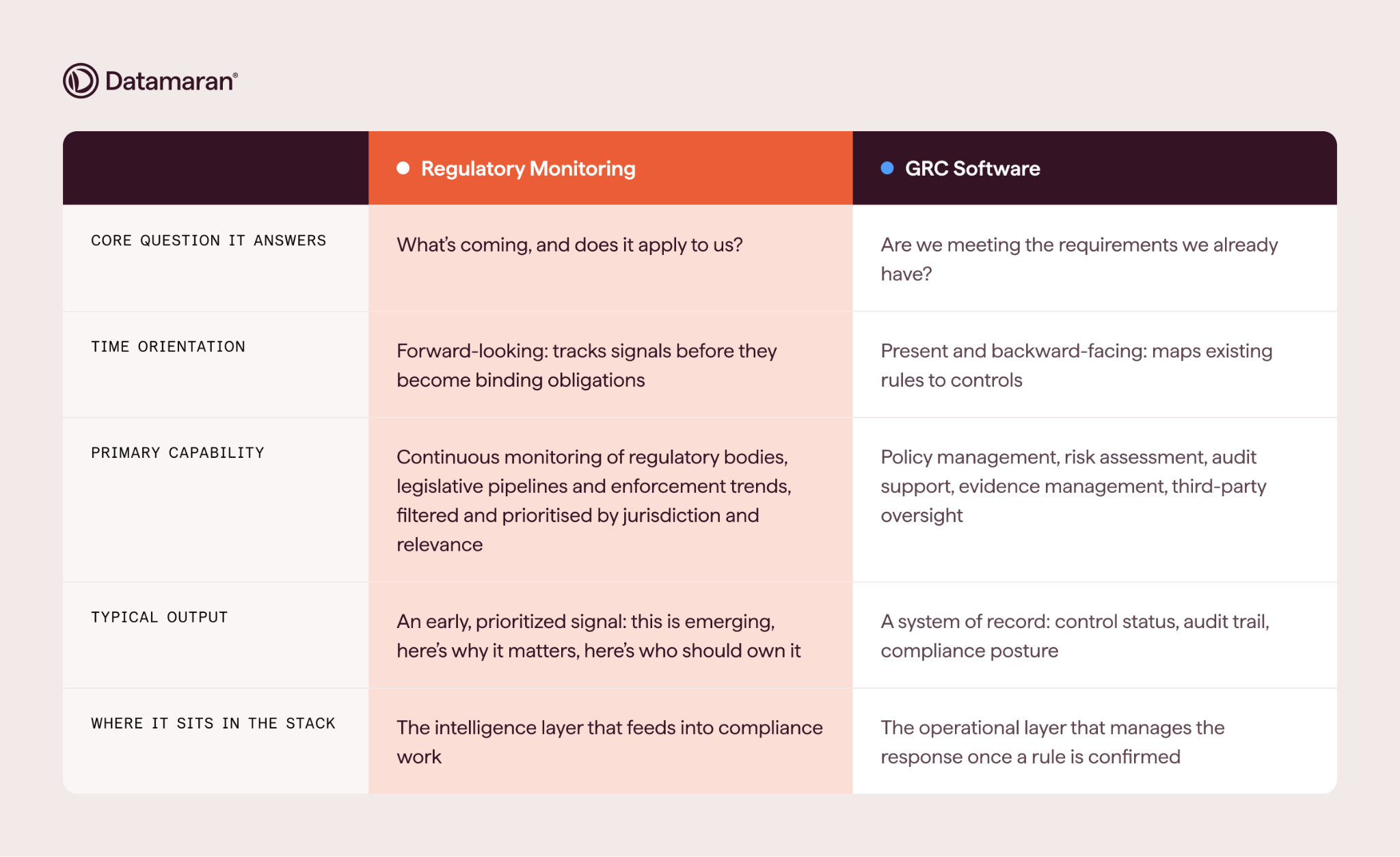
Companies that rely on GRC tools alone are well equipped to respond to confirmed rules, but often learn about emerging ones too late to respond efficiently. That delay is where much of the waste begins.
How should companies manage emerging regulatory risk?
Start with ownership, not tooling. Decide who is responsible for emerging regulation and how information flows between group and local teams, then choose the approach and tools that support that model.
- Map the emerging topics that matter to you. Identify the areas moving from soft law to binding law in your sectors and jurisdictions.
- Assign a clear owner for each. Agree how legal, compliance, sustainability, and local entities share responsibility, so work isn't missed or duplicated.
- Separate monitoring from compliance management. Be clear which people and tools spot what's coming, and which manage the response once a rule is confirmed.
- Define your applicability criteria up front. Knowing your thresholds for size, locations, revenue, and sector makes it far quicker to decide whether a new rule applies.
- Make your reasoning visible. Record how conclusions were reached, so you can answer questions from the board or auditors, and so knowledge survives team changes.
The teams that get this right treat regulatory risk as the strategic governance challenge it is, not a gap that the right spreadsheet, retainer, or dashboard can quietly close.
See how Datamaran Regulatory Monitoring helps teams spot emerging regulation early and understand what applies to them.
Datamaran publishes a weekly brief on emerging regulatory developments, a quarterly policy brief, and monthly research reports on risk topics for customers and Harbor+ members.
About Donato Calace
Donato Calace is Senior Vice President, Market Leader, Partnerships & Innovation at Datamaran. Over more than 12 years at the company, he has advised corporate leaders on using technology to identify emerging material risks and opportunities. He is a member of EFRAG’s Expert Working Group on the European Sustainability Reporting Standards and holds a PhD focused on ESG materiality.