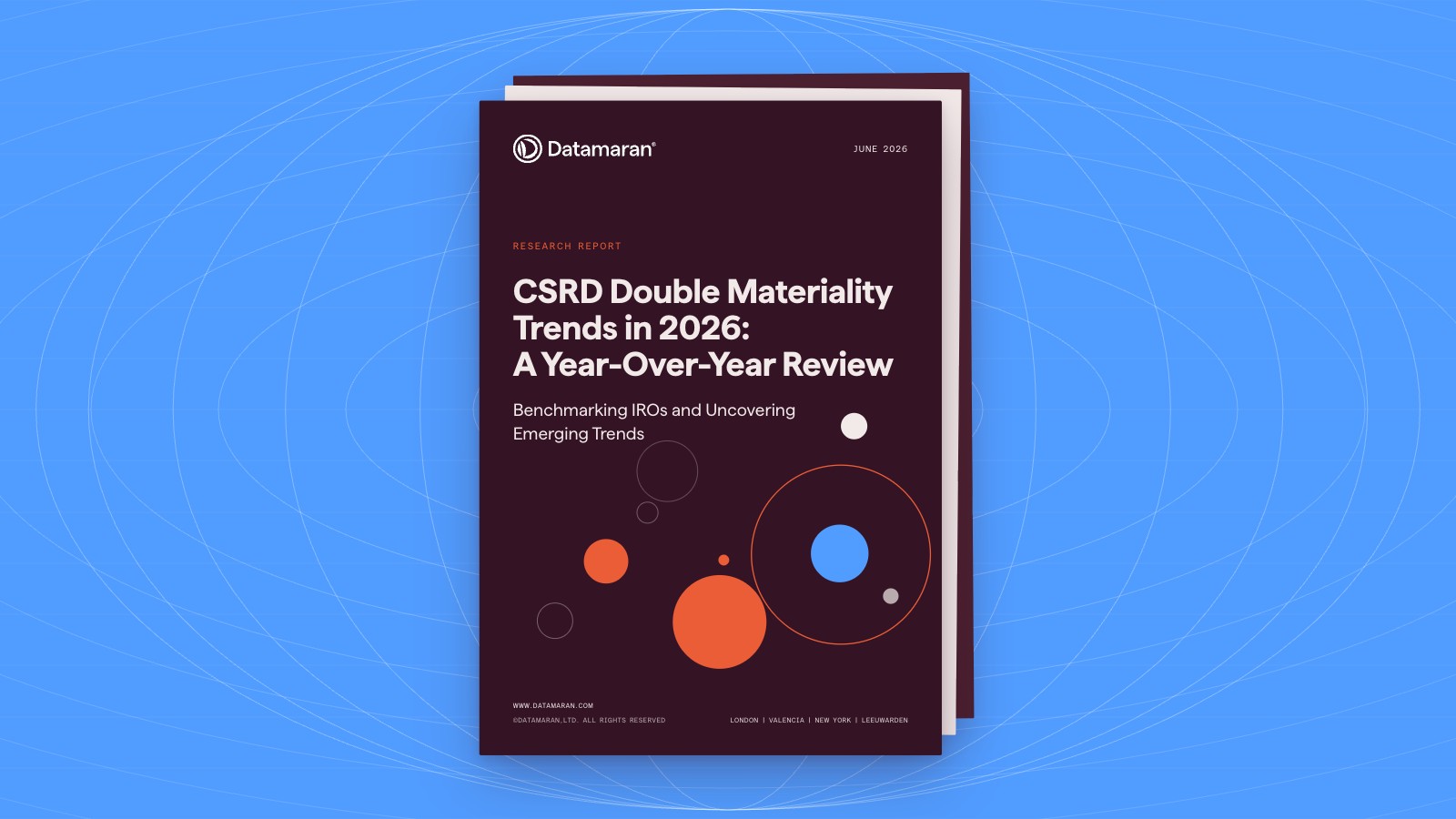
CSRD Double Materiality Trends in 2026: A Year-over-Year Review
Drawing on 20,844 IRO disclosures across 300 companies, this report tracks how double materiality is shifting under CSRD.
Introduction
Drawing on 20,844 IRO disclosures from the Datamaran platform across 300 companies, 21 countries, and 11 sectors, this report tracks year-over-year trends in how double materiality assessments are evolving across the first two CSRD reporting cycles.
Materiality scope is narrowing. Opportunity disclosures are declining. Entity-specific topics are rising fast. For many organizations, building a truly defensible, decision-useful double materiality assessment remains a work in progress.
What the data reveals
Materiality is moving, but not in the direction you might expect
88% of companies changed the number of material IROs they disclosed year-over-year, and the shifts are not random. Scope is narrowing overall, even as individual companies swap which topics they consider material as they refine their assessments.
Downside exposure still dominates disclosures
Negative impact reporting increased across every ESRS topical standard, while positive impact and opportunity disclosures declined. Companies are getting more comfortable naming risks, not the upside case for acting on them.
Some of the most scrutinized topics are seeing less coverage, not more
Biodiversity (E4), Water and Marine Resources (E3), Pollution (E2), and Affected Communities (S3) all saw fewer companies flag them as material this cycle than last. That doesn't mean the underlying risks went away, it means assessments are getting sharper about what rises to board-level attention.
Entity-specific disclosures are a growing area of CSRD reporting
The share of companies reporting at least one entity-specific IRO doubled year-over-year. Standardized ESRS topics no longer capture the full picture, and companies are increasingly willing to disclose what's actually material to their business, even when it falls outside the standard taxonomy.
What you'll learn
This report gives sustainability, risk, and reporting teams a benchmark for where double materiality assessments actually stand, not just what the standard asks for. In it, you'll find:
- Where double materiality assessments actually stand after two full CSRD reporting cycles
- Why opportunity disclosures are declining while negative impact reporting keeps climbing
- Which ESRS topics are seeing reduced coverage, and what that signals about assessment maturity
- How entity-specific IROs are reshaping what CSRD reporting actually looks like in practice
Conclusion
Two reporting cycles in, CSRD disclosures are starting to show what defensible double materiality actually looks like in practice, and it isn't static. Scope narrows as assessments mature, entity-specific issues carry more weight than the standard taxonomy alone anticipated, and the gap between disclosing a risk and disclosing the opportunity behind it is widening.
Download the full report for the complete year-over-year benchmark, sector and country breakdowns, and the methodology behind the 20,844 IRO disclosures analyzed.